Why Local Businesses Should Invest in SEO
A practical guide to capturing high-intent local demand. Learn how search visibility builds credibility, complements word-of-mouth referrals, and creates a long-term customer acquisition engine for your local business.

Entrepreneur and Coach
I
Or a logistics manager in Douala searching for a reliable freight contractor to transport specialized equipment to Yaoundé. Or a commercial property developer looking for a trustworthy structural engineering consultant nearby.
They do not open a newspaper. They rarely scroll through social media feeds hoping an advertisement pops up by coincidence. And if their immediate contacts do not have an instant recommendation, they do what millions of people do every day: they take out their phone or laptop, open Google, and search.
They type in specific terms: "emergency plumber near me," "logistics company in Douala," or "commercial structural engineer in Yaoundé."
Within seconds, Google presents a shortlist of businesses. The user scans the top results, checks a few customer reviews, clicks through to two or three websites, and reaches out to the most credible options.
Now consider the local business that provides excellent service, employs skilled staff, and offers fair pricing—but remains completely invisible on that results page.
That business did not lose a customer because of poor quality, expensive rates, or bad service. It lost the customer simply because it was not discoverable at the exact moment demand existed. This is the reality of invisible demand. Every single day, qualified buyers search for services in your area. If your business isn't there when they look, you never even enter their decision-making process.
What Local SEO Actually Means
Search Engine Optimization (SEO) is often portrayed as a mysterious, highly technical task reserved for global software companies or giant e-commerce platforms. But for a service provider, contractor, medical clinic, or local agency, Local SEO is far more grounded and practical.
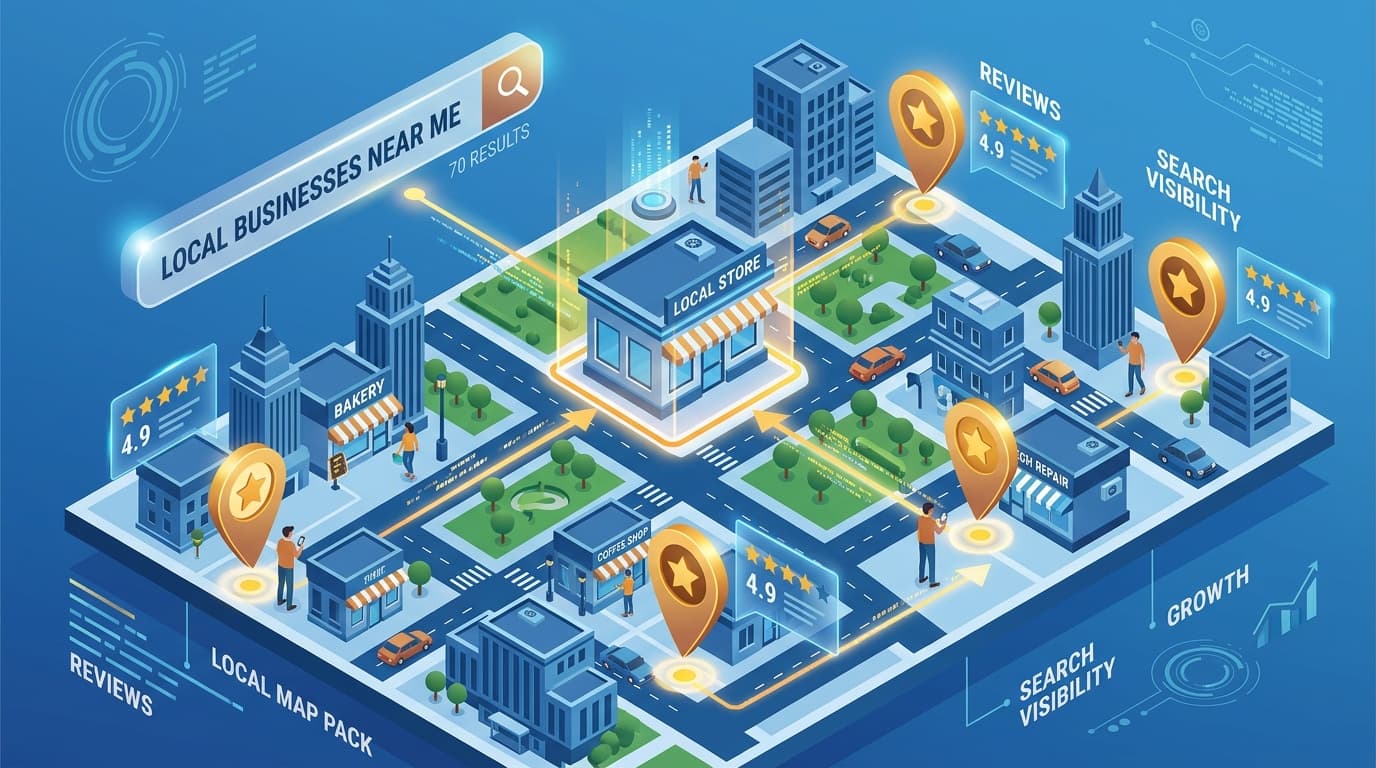
Local SEO is the process of optimizing your online presence so that your company appears prominently whenever prospective customers in your geographical area search for the solutions you offer.
Unlike traditional, broad SEO—which might aim to attract visitors from anywhere in the world—local SEO focuses on geographical relevance and local search intent. It connects your physical location or service area directly to local demand.
A complete local search presence involves several connected digital components working together:
- Google Business Profile (GBP): The official business listing that powers Google Maps and local map packs.
- Website Optimization: Clear, well-structured service pages optimized for specific services and locations.
- Geographic Relevance: Demonstrating through content, address details, and service area definitions where you genuinely operate.
- Reputation & Reviews: Collecting consistent, genuine customer feedback that validates your trust signals.
- Information Consistency: Maintaining consistent business details (Name, Address, Phone number) across verified directories and platforms.
- Technical Health: Ensuring your site loads quickly, functions flawlessly on mobile devices, and allows Google's search crawlers to index your pages efficiently.
At teChia Digital Solutions, our operational philosophy is built on three core pillars: Digitalize. Simplify. Grow. The purpose of local SEO is not to make your business look artificially "techy." The goal is to make your business easier to find, easier to trust, easier to manage, and easier to grow.
Why Search Visibility Builds Trust Before You Ever Speak to a Client
It is a mistake to believe that ranking high on Google automatically guarantees trust. Being at the top of a page simply grants you visibility. What builds credibility is what prospective customers encounter once they find you.
Modern consumers rarely make decisions based on a single piece of information. When a prospective buyer searches for a local service, they evaluate a composite set of trust signals within seconds:
- A Verified Profile: A complete Google Business Profile showing accurate operating hours, direct phone numbers, and physical address verification.
- Social Proof: Authentic reviews from real clients describing their experience with your work.
- A Professional Website: A clean, fast-loading digital home that clearly articulates what you do, who you serve, and how to get in touch.
- Transparent Details: Case studies, clear service descriptions, team bios, or portfolio photographs demonstrating proven work.
When all these elements align, search visibility acts as a powerful amplifier for your reputation. It places your company directly into the buyer's consideration set. You transition from an unknown business into a validated local provider before your sales team even answers the phone.
SEO Reduces Dependence on Referrals—Without Replacing Them
Word-of-mouth referrals are the foundation of many growing businesses. A personal recommendation carries high trust and frequently converts into a client. However, relying exclusively on referrals creates an operational vulnerability that limits business scalability.
The Core Distinction:
Referrals bring you people who have heard about you through someone else.
Search brings you people who are actively looking for what you do right now.
When a business relies entirely on referrals, its customer acquisition volume is constrained by the size, activity, and memory of its existing network. If your past clients don't happen to talk to anyone who needs your service this month, your incoming inquiry pipeline dries up.
Local SEO establishes an independent, secondary discovery channel. It connects you with buyers outside your immediate personal or professional network. The strongest local businesses do not choose between referrals and SEO; they leverage referrals for warm network growth while using local SEO to capture active market demand 24/7.
The "I Need It Now" Advantage: Understanding Search Intent
Not all traffic is created equal. A person scrolling through social media might see an advertisement for office renovation while catching up on news. They may find the visual interesting, but they were not actively seeking an office contractor at that moment.
Search traffic operates on explicit user intent. When someone opens a search engine, they are actively looking to solve a problem or gather specific information. Search queries typically fall into clear categories:
| Search Intent Type | Example Local Search Query | Customer Mindset |
|---|---|---|
| Informational | "Why is my office air conditioner leaking water?" | Seeking troubleshooting advice or learning how a problem works. |
| Commercial Investigation | "Best commercial HVAC contractors in Douala" | Comparing options, reading reviews, and shortlisting qualified providers. |
| Transactional / High-Intent | "Emergency HVAC repair service near me" | Ready to book a service call immediately to fix an urgent issue. |
| Local Discovery | "Accounting firm near me open now" | Searching for a verified local physical location or service provider nearby. |
By structuring your website content and local profile around these distinct intent levels, you capture customers at every stage of their buyer journey—from initial problem research to immediate service booking.
Google Business Profile Is Critical—But It's Only Part of the Equation
For any business operating locally, setting up a Google Business Profile is a foundational step. According to official guidelines from Google Business Profile Help, maintaining accurate, complete, and updated business details directly impacts how Google understands your local geographic relevance.
However, simply claiming your profile and leaving it static is rarely enough in competitive markets. An optimized local strategy requires active management:
- Choosing precise primary and secondary business categories.
- Publishing accurate service area boundaries and physical location details.
- Consistently adding high-quality photos of real projects, team members, and facilities.
- Systematically asking satisfied clients for honest Google reviews and replying professionally to all feedback.
- Listing specific services with clear descriptions.
While your Google Business Profile acts as your local storefront on Google Maps, it cannot handle complex client education, custom quote requests, or detailed service breakdowns on its own. That is why your business profile must be linked to a strong, well-engineered website.
Why Your Website Still Matters for Local Search
Some business owners ask: "If I have a active Google Business Profile and a social media page, do I really still need a website?"
The answer is unequivocally yes. Social media platforms and third-party directories are rented digital space. You do not own the platform, you cannot control their algorithm changes, and you are strictly limited in how you can present your business operations.
Your website serves as your digital anchor. Through professional website development, your site provides:
- Complete Service Depth: Dedicated pages for each specific service you offer, allowing you to rank for detailed long-tail search queries.
- Lead Capture Systems: Customized quotation forms, booking calendars, interactive calculators, or client inquiry portals.
- Brand Control: Unrestricted ability to present case studies, client testimonials, certifications, and project galleries without social platform distractions.
- Conversion Optimization: Designing dedicated paths that guide visitors naturally from curiosity to contact.
To understand why a professional website sits at the center of your growth strategy, explore our detailed guide: Why Every Serious Business Needs a Digital Home.
SEO and Paid Advertising Should Work Together
A common misconception in digital marketing is that businesses must choose between organic SEO and paid search advertising (such as Google Ads). In reality, these two strategies complement each other within a mature acquisition system.
Paid advertising delivers immediate visibility. The moment your campaign goes live, your business can appear at the top of search results for specific, highly competitive terms. However, the moment you pause your ad budget, that traffic stops completely.
Organic SEO takes time to build, but it creates compounding, long-term digital equity. Once your pages achieve strong rankings for relevant terms, they continue generating traffic and inquiries without charging you for every individual click.
Furthermore, both channels rely on the exact same foundation: high-performing landing pages. A well-structured, fast, mobile-optimized landing page designed for SEO will also improve your paid advertising Quality Scores, making your paid ad campaigns more cost-effective. When combined, paid ads provide short-term momentum while SEO builds long-term authority.
The Real Value of SEO Is Bigger Than Rankings
Focusing purely on keyword rankings misses the broader operational benefit of search engine optimization. The work required to rank well on Google naturally forces a company to improve its overall digital infrastructure.
To satisfy modern search engine standards, you must:
- Make your website load quickly and reliably on mobile devices.
- Structure your service offerings with extreme clarity so visitors understand what you do instantly.
- Answer common customer questions thoroughly, reducing administrative back-and-forth for your sales team.
- Organize clear contact methods, simple contact forms, and straightforward navigation paths.
In essence, good SEO practice forces you to build a better, cleaner, more user-friendly digital business. It aligns directly with automating routine customer education, an idea we explore further in How Automation Helps Small Businesses Save Time.
What Local Businesses Should Optimize First: A 4-Level Framework
To avoid feeling overwhelmed by technical jargon, local business owners should approach SEO systematically using a phased priority framework:
LEVEL 1 — FOUNDATION
Focus on core technical health and business accuracy. Ensure your business name, address, and phone number are correct online. Verify and complete your Google Business Profile. Ensure your website is fully mobile-friendly, loads quickly, and is indexable by search engines according to standard guidelines on Google Search Central.
LEVEL 2 — TRUST
Build visible social proof and clarity. Implement a routine process for collecting customer reviews on Google. Publish clear service pages with direct contact details, transparent business background, team credentials, and real project photos.
LEVEL 3 — DISCOVERABILITY
Expand your search footprint. Create dedicated individual pages for distinct core services rather than listing everything on a single generic page. Publish helpful local content that answers frequent customer inquiries, and optimize on-page title tags and headings for target service locations.
LEVEL 4 — GROWTH
Scale your operational system. Connect your search traffic to automated lead processing, conversion optimization tools, integrated CRM dashboards, or custom applications. If you're deciding when to transition from basic web pages to integrated management systems, read Website vs Business Management System: What Does Your Company Need?
Common Local SEO Mistakes to Avoid
Many local businesses waste time and resources by falling into preventable traps. Watch out for these common errors:
- Treating the Website as a Static Brochure: Building a site once and never updating its content, technical health, or service details for years.
- Inconsistent Business Details: Listing different phone numbers, addresses, or business names across social media profiles, directories, and web pages.
- Keyword Stuffing: Forcing repetitive city names and awkward keywords into sentences (e.g., "We are the best mechanic Douala mechanic service in Douala"). Search engines penalize poor writing that harms user experience.
- Neglecting Mobile Users: Designing a website that looks great on a desktop monitor but becomes broken, slow, or unreadable on a smartphone screen where local searches occur.
- Mass-Producing Generic AI Spam: Publishing dozens of low-quality, generic articles generated by AI without real industry expertise, original insights, or practical local relevance.
- Ignoring Customer Reviews: Failing to ask happy clients for feedback or ignoring negative reviews instead of responding professionally.
How Long Does Local SEO Take to Show Results?
Any agency or consultant promising that your business will "Rank #1 on Google in 30 days" is not being realistic. SEO is an ongoing strategic investment, not an instant light switch.
The timeline required to see meaningful movement depends on several variables:
- Level of Market Competition: A specialized contractor in a small city will see results faster than a personal injury lawyer or real estate firm in a densely populated commercial hub.
- Current Digital Health: A domain with an established history, existing trust signals, and clean technical structure will recover and climb faster than a brand-new domain.
- Quality and Relevance of Execution: Consistent publishing of genuine, useful content yields far faster results than sporadic, low-effort updates.
Generally speaking, most local businesses start noticing initial indexing improvements and movement in local map visibility within 3 to 6 months of steady, systematic optimization. Over 12 months, that foundation compounds into a consistent, sustainable pipeline of inbound customer inquiries.
How to Decide Whether SEO Is Worth Investing In
SEO is a powerful growth driver, but it is not the immediate priority for every single business at every stage. Use this simple decision guide to evaluate your readiness:
SEO is likely a high-value investment for your business if:
- People actively search Google for your products or services in your target market.
- Your competitors appear prominently in local search results and are winning customers you could serve.
- You want to build a long-term acquisition channel that reduces total reliance on paid ad spend or personal networking.
- You offer high-value services where winning a few additional qualified clients a month delivers a massive return on investment.
SEO may NOT be your immediate priority if:
- You offer a completely novel product with zero existing search volume (where social discovery or direct outreach is required first to create awareness).
- Your business model or core offering is unproven and actively changing every few weeks.
- Your primary physical business operations, phone systems, or fundamental service fulfillment are not yet set up to handle incoming customer leads.
The Local SEO Audit Checklist
Use this practical checklist to evaluate your company's current local search readiness:
- ☐ Our business Name, Address, and Phone number are accurate and identical across all online profiles.
- ☐ Our Google Business Profile is claimed, fully filled out, and verified.
- ☐ Our website is fast, secure (HTTPS), and renders perfectly on mobile smartphones.
- ☐ Every core service we offer has its own dedicated, clearly written web page.
- ☐ Our target geographic locations and service areas are explicitly mentioned across key pages.
- ☐ We actively collect genuine Google reviews from satisfied clients on a monthly basis.
- ☐ Every service page has a clear primary call-to-action (e.g., call button, quote form, booking link).
- ☐ We systematically track where our website inquiries and incoming sales leads originate.
Conclusion: Making Your Business Discoverable
A business can have the best team, the highest quality products, and pristine service ethics, but if local prospective buyers cannot find it when they need help, that excellence remains invisible.
Local SEO is not about tricks, shortcuts, or trying to manipulate search algorithms. It is about organizing your business information cleanly, demonstrating real trust, and ensuring that when prospective customers look for solutions in your area, your business stands ready to be discovered.
When you align your search visibility with a fast, professional digital presence, search becomes a reliable engine for long-term company growth.
Is your business invisible when local customers search for your services?
You shouldn't lose qualified customers to competitors simply because they appeared first in Google search. Whether you need to optimize your local presence, rebuild your website for conversions, or connect your digital marketing systems, teChia Digital Solutions can help.
At teChia, we partner with modern businesses to build digital presences that drive real operational growth.
Book a Free Digital Visibility AuditFrequently Asked Questions
What is local SEO?Local SEO is the practice of optimizing your website and online listings so that your business ranks prominently when prospective customers search for your products or services within a specific geographic location or service area.
How does SEO help a business that already relies on referrals?Referrals bring in customers who heard about you through personal contacts, but growth remains limited by the reach of your network. Local SEO creates a reliable second discovery channel that captures active buyers who are searching for your service without knowing your business beforehand.
Is a Google Business Profile enough, or do I still need a website?A Google Business Profile provides initial map and local pack visibility, but a dedicated website provides deep service details, lead capture systems, brand trust signals, and the ability to rank for a much wider variety of complex search queries.
How long does local SEO take to produce results?SEO is a compounding digital asset. Depending on local market competition, site health, and consistent execution, initial search indexing and local map movement typically occur within 3 to 6 months.
Can local SEO and paid advertising work together?Yes. Google Ads provide immediate visibility for targeted keywords, while organic SEO builds sustainable long-term authority. Utilizing high-quality, conversion-focused landing pages enhances performance and efficiency across both channels simultaneously.